This April, Ofgem will be reducing the price cap to £1,641 for a typical home, consuming gas and power and paying by Direct Debit. The following pages aim to help you understand the changes and why the price cap is changing on 1 April 2026.
Government changes from April 2026 - The Energy Company Obligation (ECO) and Renewables Obligation (RO)
From 1 April 2026, the Government is changing how some “policy costs” are funded on energy bills:
• The Energy Company Obligation (ECO) is being removed from energy bills.
• 75% of the Renewables Obligation (RO) costs are being moved off energy bills and into general taxation (meaning they’re funded through general Government spending rather than through bills).
These changes are a major reason why the Ofgem price cap is lower for April–June 2026 than it was in January–March 2026.
So why isn’t it the full “£150 off bills”?
You may have seen headlines about “£150 off bills” from April 2026. That figure relates to the policy-cost reductions above (moving ECO off bills and shifting most RO costs into general taxation).
However, the price cap doesn’t only reflect policy costs. It also includes things like network costs (the regulated charges for transporting energy to homes) and other allowed costs, and these have moved in the opposite direction, offsetting part of the policy saving.
That’s why the actual cap reduction for a typical household is £117, not £150.
What makes up the price cap?
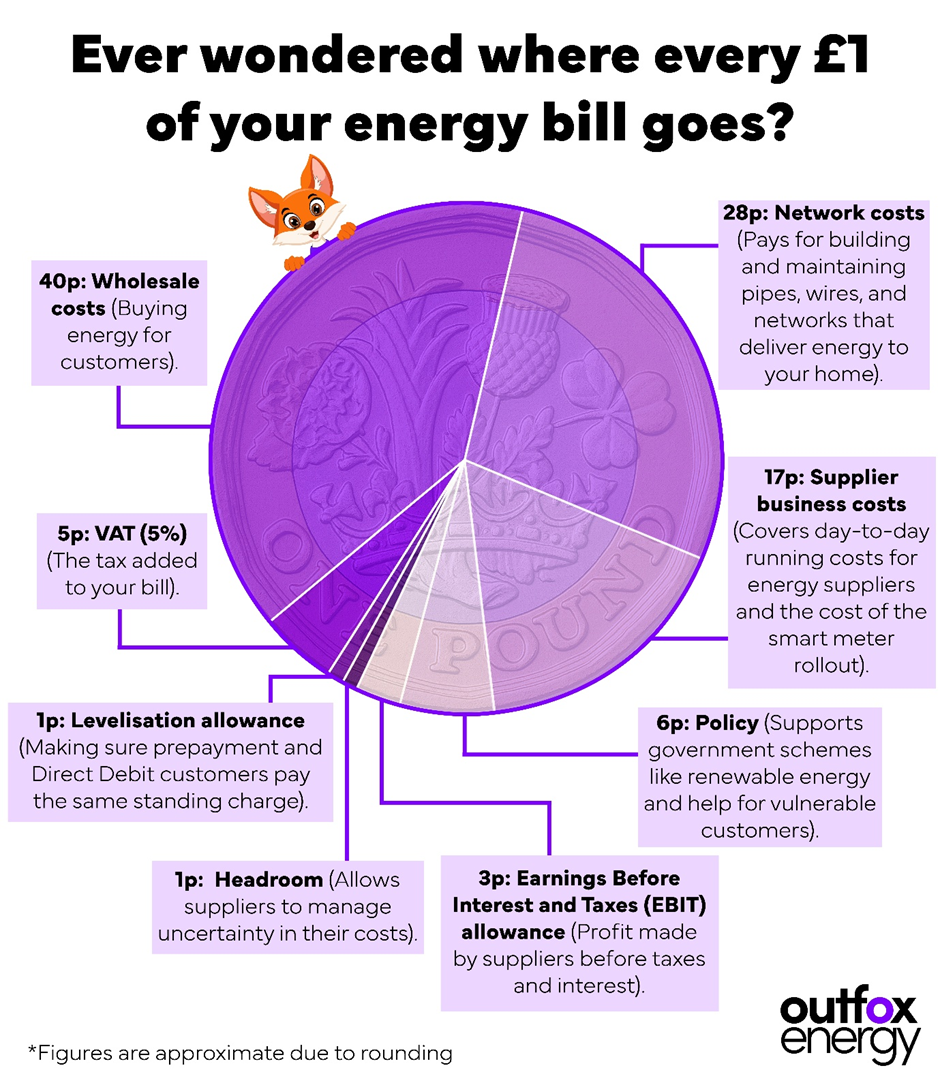
Your New Energy Prices
Between 1 April and 30 June 2026, the energy price cap is:
£1,641/year for a typical household using both gas and electricity and paying by Direct Debit - down £117 (6.6%) from £1,758/year in January–March 2026.
Your actual bill will always depend on how much energy you use.
The price cap is reviewed every three months. It sets a maximum for:
• the unit rate (what you pay per kWh), and
• the standing charge (a daily fixed amount).
The cap is updated to reflect the costs suppliers face, including wholesale energy costs and regulated charges like network costs.
The energy price cap is designed to ensure that consumers pay a fair price for the energy they use. It is adjusted regularly to reflect the costs of supplying that energy, which include wholesale energy prices, operational costs like billing and smart meter installations, and network charges for transporting energy to your home.
If you’re on a fixed tariff (from 1 April 2026), your prices (unit rates and standing charges) will stay the same until your contract ends. Your total bill will still depend on how much energy you use. If you’re on a variable tariff, the April price cap change may affect your costs.
If you're on a single-fuel tariff (either gas or electricity), it might be worth considering switching to a dual-fuel tariff to get the best prices.
Direct Debit
Direct Debit is our most popular payment method, with over 90% of our customers choosing this option. It allows you to spread your energy payments into manageable monthly amounts, so you avoid building up large credit balances or falling into debt during months of higher usage. For more details, take a look at our Direct Debit FAQs.
• Direct Debit customers save around 7% on average compared with paying on receipt of bill. Over 93% of customers already pay this way.
• Spreads payments into manageable monthly amounts
• We’ll automatically review your payments as part of our regular cycles no need to contact us.
Payment on receipt of bill (Standard Credit)
This method involves paying for the energy you’ve used over a period of time, typically between two weeks and three months. Unfortunately, this is a more expensive option, as you’ll be charged the maximum rate for your energy. You’ll also miss out on the lower prices available through Direct Debit.
• Costs more than Direct Debit (The average cost of a dual fuel bill is £1,772/year compared to £1,641 when paying by Direct Debit).
• If you’d like to reduce your costs, you can set up a Direct Debit quickly and easily online or with our team.
To make sure your next bill reflects the energy you’ve actually used. We recommend submitting a meter reading between 31st March 2026 and 3rd April 2026. It’s quick, easy, and helps you avoid surprises when the new prices take effect.
• Submit your reading online via our website on the day
• Have a smart meter? No need - your readings will come through automatically
• Don’t have a smart meter yet? You can get one installed for free. Just call SMS Plc on 0330 135 9982 to book your appointment.
If you're manually reading your meter, just check the number on your meter display and submit it via our website or app. You can find more guidance on how to read your meter here.
It's always a good idea to take a photo of your meter reading for your records. You can submit your readings quickly and easily here.
The ongoing rollout of smart meters is transforming how households manage their energy. With automatic and highly accurate meter readings, you won't need to submit them manually. Smart meters also provide you with a clearer view of your energy usage, helping you make more informed decisions about your consumption.
Here are just a few of the benefits a smart meter can offer you:
Want to get a smart meter?
You can contact SMS plc, our smart meter installation partner, directly to book an appointment by calling 0330 135 9982.
With the price cap increasing slightly, we remain more committed than ever to providing you with access to all available support if you're facing financial difficulties or struggling to pay for the energy you use.
We have a dedicated section in our FAQs outlining the support we offer, as well as details of other organisations that provide free, confidential, and impartial advice.
Click the icons below to learn more about the energy and financial support available to you:
If you have any further questions regarding the price change that haven’t been addressed in our email, PDF attachment, or in this FAQ, please don’t hesitate to contact our helpful energy specialists who will be more than happy to assist you.
The quickest way to reach our team is via our live chat feature. You’ll be connected to one of our energy specialists who will assist you with your query in real-time.
If your circumstances have changed or you are finding it difficult to pay for the energy you use, it’s important that you get in touch with us so we can arrange payment solutions and offer you personalised support.
Click on the icons below to contact us:
*Based on Ofgem’s ‘typical medium usage’ household of 2,700 kWh electricity and 11,500 kWh gas per year. Your actual bill will depend on your energy consumption.
Have a question we've not answered?
Let us know and we'll do our best to help. Furthermore, if it's a question that comes up again we'll add it as an FAQ to help others.